

Draw the wardrobe around what you own
A wardrobe that looks balanced on paper and cannot take the hanging in the house will be full of workarounds by the second month. Count first.
 Concept
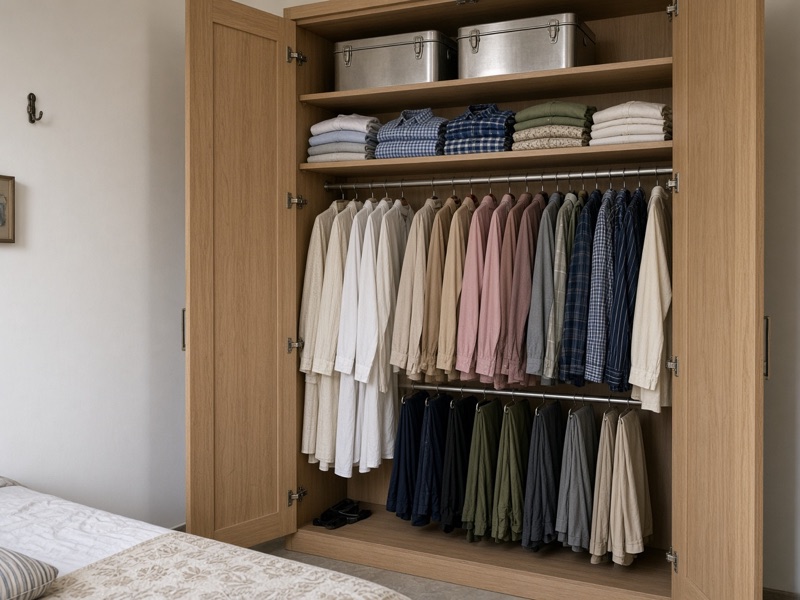
Open the existing cupboard before anyone draws a line. How much is hanging? How much is folded? How many things are in a suitcase because there was never a loft? That pile is the brief. A symmetrical run of hanging on both sides is only right if the clothes are symmetrical, which they almost never are.
In the homes we visit, one person often needs long hanging — kurtas, coats, a few sarees — and the other needs shelves and a short drop. If the drawing copies a picture, both people lose a little, and the overflow goes on a chair.
Hanging, shelves, drawers
Hanging needs a clear drop and a rod that will not sag. Shelves need a depth you can actually reach; a deep shelf becomes a place where things disappear. Drawers earn their cost when they hold the small things you would otherwise stack in a heap — underclothes, belts, the charger that otherwise lives on the floor.
You do not need every type in every bay. One bay that is only shelves is more useful than three bays that each try to be a showroom.
Use the height you already paid for
Apartment ceilings are not wasted space. A loft over the wardrobe, or over a door if the beam allows it, takes the suitcase, the extra blanket, the steel boxes you open twice a year. The last few hundred millimetres are usually more useful than another decorative shutter at eye level.
If the loft is too deep to reach, it will stay empty and you will still buy a plastic box for the passage. Depth and a simple way to get things down matter more than making the elevation look tall.
Leave the walk
A wardrobe that fills the wall still has to open. In a small bedroom the bed is already close. Full-height shutters that swing into the walk make the room smaller every morning. Sliding doors are not always the answer — they have their own depth — but the drawing has to show the swing, not only the closed face.
Bring a rough count to the visit: hanging, fold, shoes, bags. We would rather draw around that than around a module that looked good in someone else’s house.
If you keep one photograph for the visit, photograph the inside of what you have now, not a picture you like online.